How Long Does Dead Animal Smell Last Without Removal?
When you're dealing with an unpleasant smell in your home and considering whether to wait it out or call for professional help, one of the first questions that naturally comes to mind is simply: how long is this going to last? Understanding the typical timeline of decomposition odour can help you make a more informed decision about how urgently to act, rather than guessing.
At Fresho Dead Animal Removal Brisbane, we're asked this question regularly, and while every situation varies slightly depending on factors like animal size and location, there are some dependable general patterns worth understanding. In this guide, we'll walk through the typical timeline of dead animal smell and explain why waiting it out is rarely the best approach.
The General Decomposition Timeline
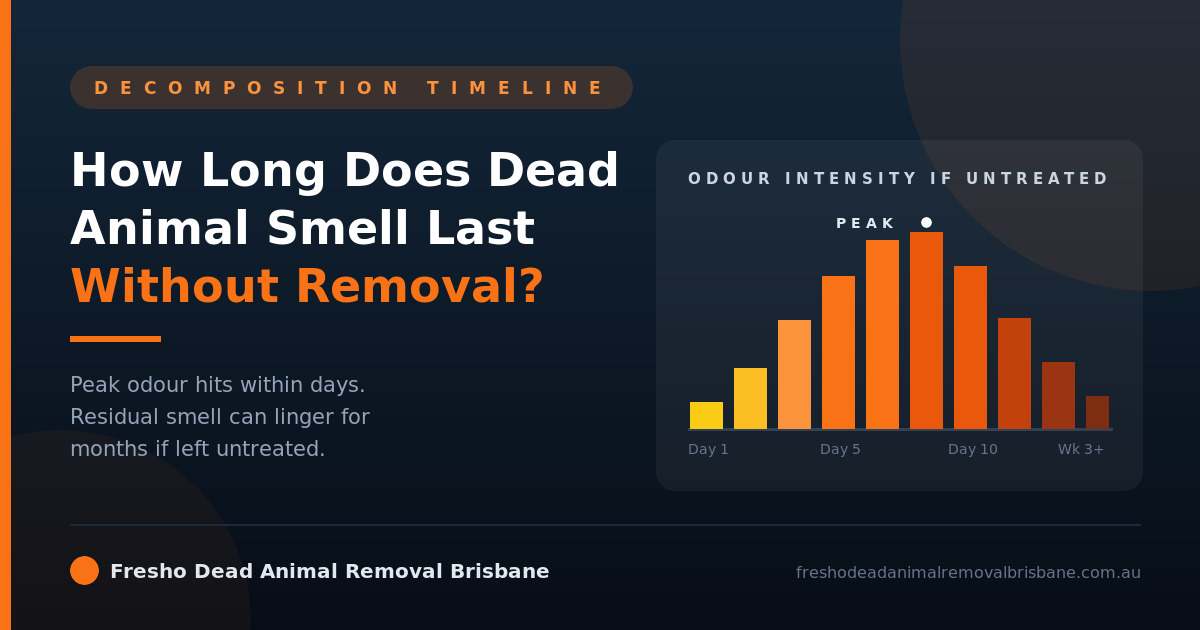
In Brisbane's warm, humid climate, decomposition typically progresses faster than in cooler regions. For a small to medium animal like a possum or rat, noticeable odour often begins within twenty-four to forty-eight hours of death, intensifying significantly over the following three to five days as bacterial activity peaks. The strongest odour period generally lasts around one to two weeks, after which it gradually begins to fade as the decomposition process moves toward its later stages.
Why Estimating an Exact Timeline Is Difficult
It's worth acknowledging that no two situations decompose identically, even under seemingly similar conditions. Factors like the animal's exact size, whether it died of illness or trauma, the specific location's airflow, and even subtle differences in ambient temperature throughout a single day can all shift the timeline somewhat. The general ranges provided here offer a useful guide, but actual experiences can vary meaningfully from one case to the next.
Comparing a Treated Case to an Untreated One
To put the difference in perspective, an untreated case might show gradually improving, but never fully resolved, odour over a period of one to three months, with occasional flare-ups during humid weather. A professionally treated case, by contrast, typically shows dramatic improvement within the same day as treatment, with any final trace of odour clearing within forty-eight hours as the area finishes drying.
Factors That Affect How Long the Smell Lasts
- Animal size: larger animals produce more decomposition fluid and typically longer-lasting odour
- Temperature and humidity: warmer, more humid conditions accelerate bacterial activity and odour intensity
- Location: enclosed spaces like roof cavities or wall voids tend to concentrate and prolong noticeable odour
- Ventilation: poorly ventilated areas allow odour to build up and linger longer than well-ventilated ones
- Whether fluids have soaked into surrounding materials, which can extend the odour timeline considerably
Why the Smell Doesn't Simply Disappear on Its Own
While the strongest, most intense phase of decomposition odour does eventually pass as the process moves through its stages, this doesn't mean the smell disappears fully on its own timeline that homeowners might hope for. Residual bacteria in contaminated insulation, timber, or other materials can continue producing a fainter, but still noticeable, musty or unpleasant smell for weeks or even months beyond the initial, most intense odour period, particularly in humid conditions that support ongoing bacterial activity.
The Difference Between 'Fading' and 'Fully Resolved'
It's worth distinguishing between an odour that's simply becoming less intense as decomposition progresses naturally, and one that's actually been fully resolved through proper removal and treatment. A fading smell can still leave behind bacterial contamination in surrounding materials that produces a lingering, lower-level odour indefinitely, particularly noticeable during humid weather or when air conditioning circulates air through the affected space, until the contaminated material is properly treated or removed.
How Location Within the Home Affects the Experience
A dead animal decomposing in a rarely used spare room might go unnoticed for longer than one in a main living area or bedroom, simply due to less frequent time spent in that space. This can sometimes mean the odour has progressed further into later decomposition stages by the time it's actually noticed and addressed, compared to a more immediately obvious location.
What a Full Timeline Might Look Like in Practice
For a typical Brisbane case involving a possum in a roof cavity: faint odour might first appear around day one to two, becoming clearly noticeable and unpleasant by day three to five, reaching peak intensity around days five to ten, then gradually, though incompletely, diminishing over the following weeks if left entirely untreated, with residual musty odour potentially persisting for months without proper intervention.
What Happens After the Skeleton Remains
Once soft tissue decomposition is largely Final Check, typically several weeks after death depending on conditions, the strongest odour compounds diminish considerably, though remaining skeletal material and any dried, residual tissue can still produce a faint, musty smell for an extended period. At this stage, while the odour is far less severe than during peak decomposition, full resolution still generally requires removing the remains and treating any contaminated surrounding material.
How Timeline Differs Between Small and Large Animals
A small animal like a mouse produces a comparatively brief, though still unpleasant, odour period, often resolving its most intense phase within a week or so given its smaller mass. A larger animal, such as an adult possum, produces significantly more decomposition fluid and tissue mass, extending the intense odour phase and increasing the likelihood of fluid contamination spreading into surrounding insulation or building materials.
Why Waiting It Out Is Rarely the Best Strategy
Given that a fading smell doesn't necessarily mean full resolution, and that waiting allows more time for fluid contamination to spread into surrounding materials, choosing to wait rather than address the issue promptly rarely works out as the more convenient option in practice. Our detailed article on What Happens If You Leave a Dead Animal in Your Roof or Wall? covers the specific risks and escalating costs linked to delaying professional removal.
How Professional Removal Changes the Timeline
Professional removal and enzyme-based treatment dramatically shortens the overall odour timeline compared to waiting for natural decomposition to run its course. Rather than weeks or months of gradually fading, but not fully resolved, odour, professional treatment typically achieves substantial improvement within the same visit, with any very faint residual smell clearing within a day or two as the treated area finishes drying.
Signs the Smell Has Moved Past the Point of Simply Waiting It Out
- The smell has persisted for more than a week without any noticeable improvement
- Ceiling or wall staining has started to develop
- Fly activity has increased around a specific area
- The odour worsens noticeably during humid weather or when air conditioning is used
Frequently Asked Questions
-
How long does dead animal smell typically last if left alone?
The most intense odour period generally lasts one to two weeks, though a fainter, lingering smell from residual bacterial contamination can persist for weeks or months beyond that without proper treatment. -
Does the smell eventually go away comprehensively on its own?
The most intense phase does fade as decomposition progresses, but contaminated surrounding materials can continue producing a lower-level odour indefinitely unless properly treated. -
Does animal size affect how long the smell lasts?
Yes, larger animals produce more decomposition fluid and tissue mass, generally extending the intense odour phase compared to smaller animals like mice. -
Is it worth just waiting for the smell to go away naturally?
Generally not recommended, since waiting allows more time for fluid contamination to spread into surrounding materials, often making eventual professional treatment more extensive and costly. -
How quickly does professional treatment resolve the odour compared to waiting?
Professional treatment typically achieves substantial improvement within the same visit, compared to weeks or months of gradually fading, but not fully resolved, odour if left untreated. -
Can the smell get worse before it gets better, even with treatment?
It's uncommon, but a very faint residual smell can sometimes be noticeable immediately after treatment as the enzyme solution actively works, which typically clears within a day or two as the area dries. -
Does the type of location, like a wall versus a roof, affect the timeline?
Enclosed spaces with limited airflow, such as wall cavities, can sometimes concentrate odour more noticeably, though the underlying decomposition timeline itself is driven more by temperature and animal size than location alone.
Final Thoughts
While dead animal odour does naturally diminish over time as decomposition progresses, the timeline for genuine, comprehensive resolution is far longer than most homeowners expect, and a fading smell doesn't necessarily mean the underlying contamination has been addressed. Professional removal and treatment offers a dramatically faster, more dependable path to a genuinely odour-neutralised home.
If you're dealing with a dead animal smell and wondering whether it's worth waiting out, contact Fresho Dead Animal Removal Brisbane today for a fast, thorough resolution rather than an uncertain waiting game.