Dead Animal Smell in Car: What to Do and Who to Call
There are few smells as unmistakable, or as unpleasant, as a dead animal in car. Whether it hits you the moment you open the door on a hot Brisbane afternoon or slowly builds over a few days of driving, that thick, sour, rotting odour is hard to ignore and even harder to live with. Unfortunately, cars offer plenty of hidden spaces for small animals to crawl into and, sometimes, never crawl back out of.
At Fresho Dead Animal Removal Brisbane, we get calls regularly from drivers who are baffled by a smell they simply cannot locate or shift. The good news is that a dead animal smell in a car is almost always solvable once you know where to look and how to approach the clean-up safely. This guide covers exactly what causes the odour, how to track it down, and when it makes sense to call in a professional rather than tackling it yourself.
Why Does My Car Smell Like Something Died?
If your car has a persistent foul odour that seems to intensify on hot days or after the vehicle has been sitting for a while, a decomposing animal is one of the most common causes. Small animals are drawn into vehicles seeking warmth, shelter, or a place to nest, particularly when a car is parked near bushland, garages, or gardens for extended periods. Once inside the engine bay or under the chassis, an animal can become trapped, injured, or simply die of natural causes, and decomposition does the rest.
Common Culprits: What Kind of Animal Dies in a Car?
Brisbane's mix of suburban gardens and nearby bushland means a surprising range of animals can end up inside a vehicle. Rodents such as rats and mice are the most frequent offenders because they are small enough to squeeze through tiny gaps in the engine bay. Possums occasionally climb into wheel arches or engine compartments seeking shelter, while birds sometimes build nests in air intakes or under the bonnet, only for a chick or adult to die in place.
- Rats and mice, often nesting near the engine or cabin air filter for warmth.
- Possums, particularly around wheel arches or under-bonnet cavities.
- Birds, especially in air intakes, engine bays, or behind bumpers.
- Small reptiles or amphibians, in rarer cases, sheltering in wheel wells.
How Animals Get Into Vehicles in the First Place
Cars have more entry points than most people realise. Gaps around the engine bay, wheel arch liners, air intake vents, and even the underside of the dashboard through the cabin air filter housing all provide access for a determined small animal. Vehicles parked for long stretches, especially overnight in garages, carports, or driveways near vegetation, are the most common targets because they offer a still, sheltered environment that mimics a natural den.
The Health Risks of a Decomposing Animal in Your Car
A dead animal inside a vehicle is not just an unpleasant smell to put up with, it is a genuine hygiene concern. As decomposition progresses, bacteria multiply rapidly and can be circulated through the cabin via the air conditioning or heating system if the carcass is near the intake. This can trigger headaches, nausea, and respiratory irritation for anyone travelling in the car, particularly on longer trips.
Brisbane's warm, humid climate accelerates this process significantly. A useful explanation of why heat speeds up decomposition and intensifies odour so quickly is covered in our related article, Why Dead Rats Smell Worse in Summer: The Brisbane Heat Factor, which explains why a small rodent can create such an overwhelming smell in such a short amount of time.
Step-by-Step: What to Do When You Suspect a Dead Animal
If you notice a strong, sour, rotting smell in or around your car, work through the following steps before jumping to conclusions or attempting a full teardown of your vehicle.
- Park the car in an open, well-ventilated area rather than an enclosed garage.
- Open all doors, the bonnet, and the boot to allow airflow and help you pinpoint the strongest source of the smell.
- Check obvious areas first, including under the bonnet, around the wheel arches, and near the air intake grille.
- Avoid running the air conditioning or heater until the source is found, as this can spread bacteria and odour into the cabin.
- If you cannot locate or safely reach the source, contact a professional dead animal removal service.
DIY Search Tips: Where to Look First
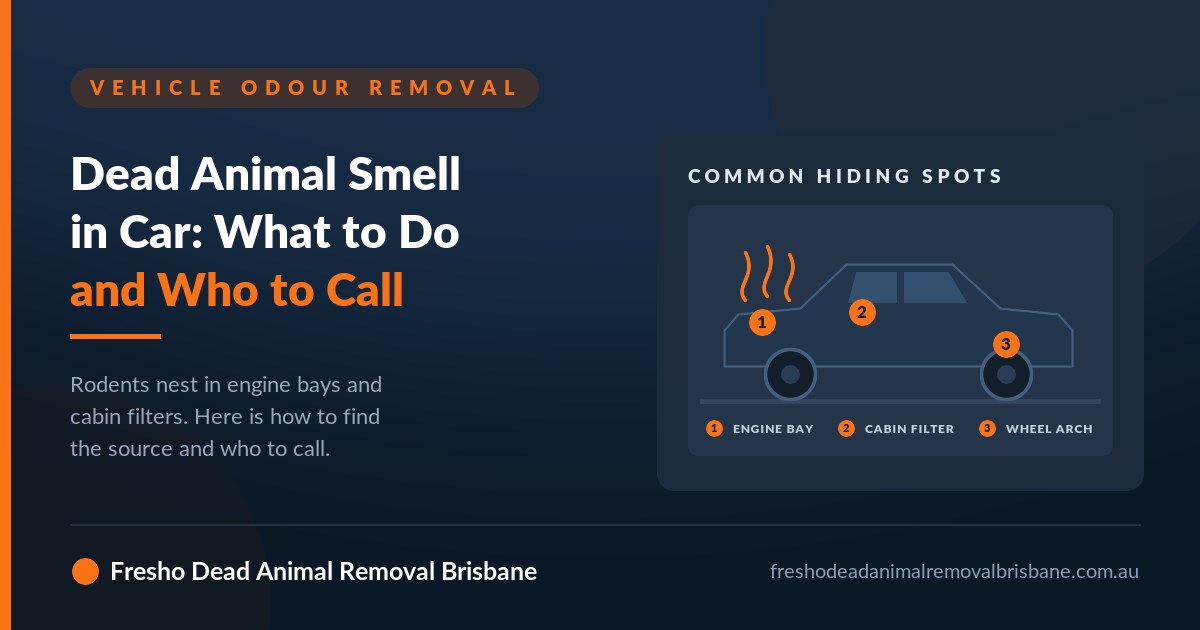
A torch and a bit of patience go a long way. Start with the engine bay, checking around the air filter housing, wiring looms, and any warm nooks near the exhaust manifold, since these areas often attract animals for warmth. Next, inspect the wheel arch liners from both above and below, as this is a favourite hiding spot for possums and larger rodents. Finally, check the cabin air filter, usually located behind the glovebox, since a dead mouse here can send odour straight through the ventilation system.
Why DIY Removal Can Go Wrong
While locating the smell yourself is often possible, actually retrieving the carcass safely is a different matter. Decomposing remains can be brittle, difficult to reach, and located in spots that require partial disassembly of trim panels, wheel liners, or ducting. Attempting removal without the right tools risks damaging your vehicle, leaving contaminated residue behind, or missing part of the carcass entirely, which means the smell simply returns days later.
- Damaging wiring, trim, or panels while trying to reach a hidden carcass.
- Leaving behind fluids or fragments that continue to smell and harbour bacteria.
- Direct contact with bacteria and parasites without appropriate protective equipment.
- Wasted time and repeat call-outs to a mechanic if the smell is not fully resolved.
Professional Dead Animal Removal vs DIY: What's the Difference
A professional dead animal removal technician brings specialised detection tools, protective equipment, and experience with vehicle structures that make the job faster, safer, and far more thorough than a DIY attempt. Beyond simply removing the carcass, professionals also sanitise and deodorise the affected area, which is the step most DIY efforts miss entirely. A lingering bacterial residue is often the reason a smell seems to fade and then return a week later.
How to Get Rid of the Smell for Good
Removing the animal is only half the job. Odour molecules and bacterial residue can soak into foam, carpet underlay, and insulation material inside the cabin and boot, which is why professional deodorisation and sanitisation treatments are important for a lasting fix. In stubborn cases, particularly where the smell has reached the cabin air filter or ventilation ducting, a full clean and filter replacement may be necessary to fully clear the air.
Odour neutralising treatments work differently to simple air fresheners, which only mask a smell rather than eliminating it. A proper treatment breaks down the bacteria responsible for the odour at a molecular level, rather than layering a new scent over the top of a lingering problem. This is particularly important in vehicles, where residual bacteria left in carpet underlay or foam padding can continue to smell for weeks if it is not fully treated.
What Does Dead Animal Removal From a Car Typically Cost?
Pricing depends on how accessible the carcass is and how much of the vehicle needs to be checked or partially dismantled to reach it. A straightforward removal from an easily accessible spot, such as a wheel arch liner, is generally quicker and more affordable than a job requiring removal of interior trim or ducting to reach a carcass lodged near the cabin air filter. Most professional providers, including Fresho Dead Animal Removal Brisbane, offer an upfront quote once the situation has been assessed, so there are no surprises before work begins.
Preventing Future Animal Intrusions in Your Car
Once the immediate problem is resolved, a few simple habits can reduce the chance of it happening again, particularly if you park near gardens, bushland, or a garage that offers easy shelter for small animals.
- Park in open, well-lit areas where possible rather than dense garden edges.
- Start your car regularly if it sits unused for long periods, as engine noise and vibration discourage nesting.
- Keep garages and carports clear of clutter that could shelter rodents near your vehicle.
- Consider a rodent deterrent spray or mesh guard around key entry points if you live in a high-risk area.
Frequently Asked Questions
-
How do I know if the smell in my car is a dead animal?
A dead animal smell is typically sour, sweet, and rotten all at once, and it tends to get stronger in warm weather or when the car has been parked for a while. If it worsens with the air conditioning on, that is a strong indicator. -
How long does it take for a dead animal to smell in a car?
In Brisbane's warm climate, a smell can develop within 24 to 48 hours, and sometimes faster during summer when engine bay temperatures accelerate decomposition. -
Can a dead animal in my car make me sick?
Yes. Bacteria and gases released during decomposition can cause headaches, nausea, and respiratory irritation, especially if the smell is circulating through the ventilation system. -
Where do animals usually die in a car?
The most common spots are the engine bay, wheel arch liners, air intake areas, and the cabin air filter housing behind the glovebox. -
Should I try to remove the dead animal myself?
You can search for the source yourself, but retrieval and full sanitisation are best left to a professional, particularly if the carcass is in a hard-to-reach or partially disassembled area. -
Will the smell go away on its own?
Eventually, but it can take weeks and often leaves lingering bacterial residue and staining. Professional removal and deodorisation resolves it far faster and more comprehensively. -
Do you provide same-day dead animal removal for vehicles?
Yes, we offer fast, hygienic removal services and can typically respond quickly to help locate and remove the source of the odour. -
Can a dead animal damage my car?
Yes. Decomposition fluids can corrode wiring insulation and stain trim or carpet, so prompt removal helps limit any lasting damage to your vehicle.
Final Thoughts
A dead animal smell in your car is unpleasant, but it is a solvable problem once you know where to look and how to approach it safely. Acting quickly limits the health risks, protects your vehicle from lasting damage, and gets you back to a fresh-smelling drive sooner rather than later.
If you have searched and still cannot pinpoint the source, or you would simply rather leave the job to the professionals, Fresho Dead Animal Removal Brisbane is here to help with fast, hygienic, and thorough service. Get in touch today and let us look after it for you.